

SupraSimFit
Molecular Binding Assay Fitting Toolkit
Fit equilibrium binding models directly to fluorescence titration data.
SupraSimFit is an open-source desktop application for determining association constants (Kₐ) from direct-binding, indicator-displacement, and guest-displacement assays.
Designed for supramolecular and biochemical research, SupraSimFit uses rigorous mass-action equilibria and nonlinear forward modelling instead of linearised binding transforms.
Download SupraSimFit
View on GitHub
Available for Windows, macOS, and Linux. No Python installation is required for the packaged application.
Developed by Ahmad Omira, M.Sc
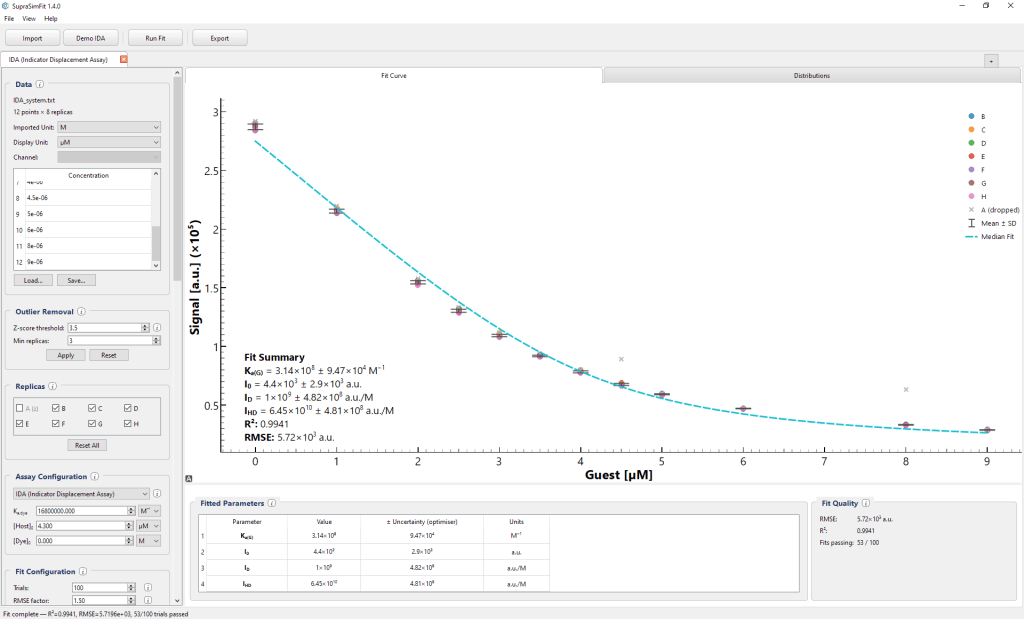
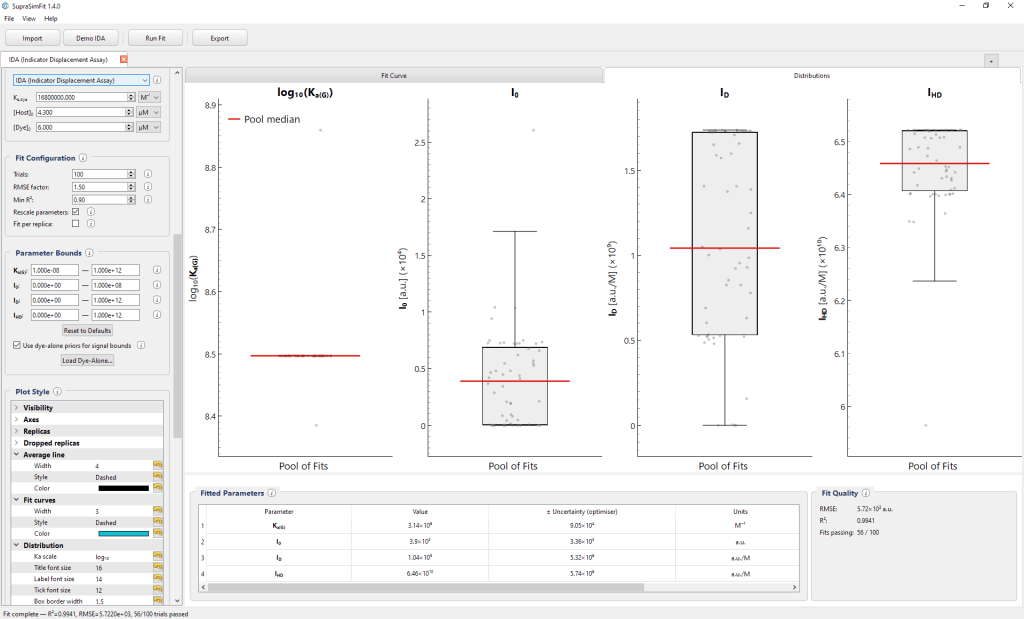
Binding Analysis Made Accessible
SupraSimFit combines scientifically rigorous binding models with an intuitive graphical interface. Experimental data can be imported, inspected, fitted, and exported without writing code.
The software is particularly suitable for researchers who need to determine Kₐ values from fluorescence titrations involving competitive equilibria, ligand depletion, multiple experimental replicas, or spectroscopically silent analytes.
Key Features
Multiple Binding-Assay Models
Analyse Direct Binding Assays, Indicator Displacement Assays, Guest Displacement Assays, and dye-only calibration measurements.
Robust Nonlinear Fitting
Fit raw fluorescence signals directly using full mass-action models rather than linearised approximations.
Multi-Start Optimisation
Run repeated constrained optimisations from different initial parameter combinations to reduce the risk of convergence to local minima.
Interactive Desktop Interface
Configure models, inspect data, remove outliers, run fits, and review results through a PyQt6 graphical interface with interactive plots.
Plate-Reader Data Import
Import BMG LABTECH™ plate-reader Excel exports with one click, or load JASCO™ Spectra Manager titration files and PerkinElmer EnSight plate-reader exports directly from CSV. Structured TXT, CSV, XLSX, and XLS files are also supported.
Replica-Aware Analysis
Process multiple experimental replicas and optionally identify anomalous measurements using a robust median- and MAD-based modified Z-score method.
Unit-Aware Inputs
Enter concentrations and binding constants in commonly used units, including nM, µM, mM, M, M⁻¹, and related units.
Flexible Result Export
Export complete fit ensembles as JSON, human-readable reports as TXT, processed raw data as TXT or CSV, and plots as PNG or SVG.
Supported Binding Assays
Direct Binding Assay
Direct Binding Assays measure the interaction between a host and a spectroscopically active dye or guest.
A host H binds directly to a spectroscopically active dye D:
H + D ⇌ HD
Kₐ,dye = [HD] / ([H][D])
The observed fluorescence is modelled as a four-parameter linear combination:
I = I₀ + Idye,free · [Dfree] + Idye,bound · [HD]
where I₀ absorbs baseline offsets and + Idye,free, Idye,bound are the per-species molar signal coefficients.
SupraSimFit supports both common titration modes:
- Host titrated into dye DBA Host-Dye
- Dye titrated into host DBA Dye-Host
Indicator Displacement Assay
Indicator Displacement Assays determine guest binding constants through competition between an analyte and a spectroscopic reporter dye fort he same host binding site.
The assay contains two coupled equilibria:
H + D ⇌ HD
H + G ⇌ HG
The reporter-dye HD affinity constant Kₐ,dye is normally determined independently using a Direct Binding Assay. During the displacement experiment, guest G is titrated into a preformed HD complex. As G displaces D, the observed signal tracks the free-dye / bound-dye ratio, letting the fit recover Kₐ,guest from the same 4-parameter signal model as DBA applied to the coupled mass-balance at each titration point.
Guest Displacement Assay
Guest Displacement Assays determine guest binding constants by titrating a reporter dye into a pre-equilibrated host–guest mixture.
The reporter dye competes with the guest for the same host-binding site. The resulting fluorescence response is fitted using the coupled host–dye and host–guest equilibria.
The fitted physical quantity is Kₐ,guest
Dye-Alone Calibration
Dye-only measurements establish the baseline fluorescence response of the unbound reporter.
A linear fit of fluorescence against dye concentration determines:
- The baseline signal, I₀
- The free-dye response coefficient, Idye,free
These parameters can subsequently be used as fixed values or informed constraints in DBA, IDA, and GDA analyses.
Dye-alone calibration can improve model identifiability and help account for concentration-dependent signal behaviour, including potential inner-filter effects.
Why Forward Modelling?
Traditional Scatchard, Hill, and double-reciprocal approaches transform the original binding isotherm into a form that can be analysed using linear regression.
However, these transformations can:
- distort the measurement noise structure (non-uniform error weighting in the transformed space),
- lose validity in ligand-depletion regimes, and
- cannot handle coupled competitive equilibria without strong approximations.
SupraSimFit instead fits the raw signal directly with the full nonlinear model — so the residual is evaluated in the measurement space where the experimental error is best understood.
Fitting Strategy
The nonlinear binding likelihood is typically multi-modal, so single-start gradient methods get trapped in local minima. The toolkit uses:
- Multi-start L-BFGS-B — the constrained quasi-Newton optimiser is launched from many random initial parameter vectors (the n_trials knob), with Ka parameters sampled in log space (they span several orders of magnitude).
- Physical bounds — every parameter has lower/upper bounds so the search stays inside a thermodynamically reasonable region (Ka defaults: 10⁻⁸ to 10¹² M⁻¹). Tighten these in the Bounds panel when you have prior knowledge.
- Quality filter — after all starts complete, failed fits are rejected by min_r_squared and by an RMSE tolerance factor (rmse_threshold_factor × best_RMSE). Only survivors are aggregated.
- Robust aggregation — the final parameter estimate is the median of the surviving ensemble, and uncertainty is reported as the median absolute deviation (MAD). This captures nonlinear uncertainty propagation without assuming a Gaussian posterior and is robust to a handful of bad fits slipping through the filter.
- Replica outlier removal — the optional Z-score preprocessing step uses a modified Z-score based on the median and MAD, so it is not biased by the very outliers it is trying to flag.
Open-Source Research Software
SupraSimFit is distributed as open-source software under the GNU General Public License v3.0.
Researchers can inspect the implemented binding models, reproduce the analysis workflow, contribute improvements, and adapt the toolkit to new experimental requirements.
The source code, documentation, example datasets, and installation instructions are available on GitHub.
Running the application from source currently requires Python 3.13 or later and the uv package manager.
Address
Hermann-von-Helmholtz-Platz 1, 76344 Eggenstein-Leopoldshafen, Germany
Call Us
+49 721 608 26341
Email Us
service@suprabindinglab.org